

Stepping into a newly leased apartment often feels like entering a sensory blank slate. Standard off-white walls, industrial-grade carpeting, builder-grade flush-mount light fixtures, and plastic vertical blinds dominate the landscape. Property management companies design these interiors for rapid turnover and universal neutrality, leaving tenants with spaces that feel functional yet distinctly devoid of character. The central challenge of apartment living is bridging the gap between making a space feel authentically like home and adhering to a strict lease agreement designed to penalize the slightest permanent modification.
Reclaiming your living space does not require structural renovation or forfeiting your security deposit. By approaching the apartment through a lens of reversible design, you can layer color, texture, architectural interest, and warmth over sterile surfaces. The secret lies in investing in portable design assets—elements that mask builder-grade finishes while living there and pack neatly into moving boxes when your lease concludes.
Transforming Walls Without the Paint Roller
Painting an entire apartment can inject instant personality, but the reality of spending an entire weekend applying two coats of primer to restore the original landlord-approved beige at move-out is enough to deter most renters. Fortunately, vertical surfaces can be dramatically reworked using non-damaging materials that introduce pattern and visual depth.
High-quality peel-and-stick wallpaper has completely shifted the rental design equation. Modern removable wallpapers utilize low-tack adhesives that bond smoothly to standard drywall and pull away cleanly years later without peeling paint or leaving gummy residues. Rather than papering an entire living room, consider applying a bold, textured grasscloth or geometric print to a single architectural accent wall—such as the recessed niche behind your bed or the entryway wall.
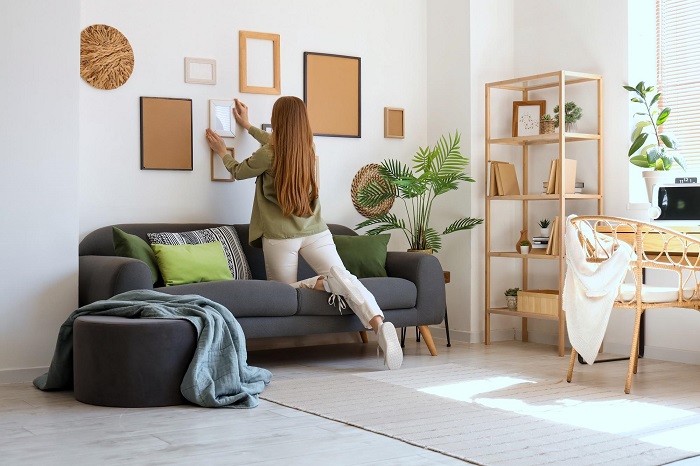
If temporary wallpaper feels too labor-intensive, vertical real estate can be redefined through oversized artwork. Hanging heavy frames historically required wall anchors and exploratory drywall holes, but modern interlocking adhesive picture strips comfortably hold frames weighing up to sixteen pounds when applied correctly to clean walls.
For even larger visual statements, bypass the wall entirely: lean a tall, framed architectural mirror or an oversized canvas directly against the wall atop a credenza, fireplace mantel, or directly on the floor. Leaning art introduces a relaxed, European salon aesthetic while reducing wall penetrations to zero.
Overriding Builder-Grade Lighting
Few design flaws sap the comfort of a home faster than harsh, overhead lighting. The ubiquitous flush-mount ceiling light—often colloquially termed the “boob light”—casts an unflattering downward glare that flattens interior dimensions and makes living spaces feel clinical. Because tenants cannot rewire ceiling junction boxes without licensed contractors and landlord consent, lighting strategy must shift to portable fixtures.
Establish a three-tiered lighting plan consisting of ambient, task, and accent illumination. Floor lamps with wide fabric drums or paper shades disperse soft, diffused light across ceiling planes, visually lifting room height. Arc lamps work wonders in living rooms, curving overhead to illuminate a coffee table without requiring a hardwired chandelier. On sideboards and nightstands, table lamps equipped with warm-spectrum smart bulbs (ranging between 2700K and 3000K) create intimate pockets of warmth that draw the eye away from bland ceiling fixtures.
For areas that desperately need overhead focus, such as a dining table or kitchen island, look to plug-in swag pendants. These fixtures hang from minimal ceiling hooks and run a fabric-wrapped cord down the wall to a standard outlet. When concealed behind a neat cord cover or draped with intentional architectural slack, a plug-in pendant provides the focal impact of custom lighting with zero electrical work.
Camouflaging Unflattering Floors and Countertops
Rental flooring is notoriously difficult to love. Decades of heavy foot traffic often leave faux-wood vinyl scratched, and wall-to-wall synthetic carpeting frequently carries a dull, institutional gray hue. Replacing flooring is out of the question, but concealing it is entirely within your control.
The most effective tool for reclaiming floor space is the strategic rug layering technique. In living rooms burdened with unsightly wall-to-wall carpeting, lay down a substantial, low-pile neutral base—such as an eight-by-ten or nine-by-twelve natural fiber jute or flatweave rug. This creates a fresh, clean foundation that visually cancels out the underlying carpet.
Over this base, layer a smaller, high-character accent rug, such as an antique Persian runner or a plush Moroccan wool piece beneath the seating area. This anchoring effect visually defines living zones in open-concept layouts while providing sound absorption that softens the echoes typical of multi-family buildings.
In the kitchen and bathroom, peel-and-stick vinyl floor decals and removable faux-stone contact paper offer a temporary antidote to dated surfaces. High-grade vinyl tile stickers can be applied directly over stained linoleum or worn ceramic tiles, resisting water and foot traffic until you peel them up with the gentle heat of a hair dryer. Similarly, covering yellowed laminate kitchen counters with thick, heat-resistant, removable marble-patterned contact paper instantly upgrades the culinary workspace without causing permanent substrate damage.
Upgrading Touchpoints and Hardware
One of the quickest ways to elevate a rental from basic to bespoke is addressing tactile touchpoints. Builders typically install the cheapest available stamped metal knobs on kitchen cabinetry, hollow plastic switch plates, and restrictive, low-flow showerheads. Because these components are held in place by simple screws, they represent prime opportunities for high-impact, temporary swaps.
Remove standard cabinet pulls and replace them with solid unlacquered brass, matte black steel, or fluted ceramic hardware. Replace the landlord’s chrome bathroom faucet handles and install a high-pressure, handheld filtered showerhead that turns an ordinary shower stall into a spa-like retreat.
The essential rule for hardware upgrades is strict inventory preservation. Designate a sturdy plastic storage container in your utility closet. As you unscrew original knobs, pulls, switch plates, and showerheads, place them inside labeled zip-top bags alongside their original mounting screws. When moving day arrives, spend an hour swapping the original components back into place, taking your upgraded designer hardware with you to your next home.
Softening Architecture with Elevated Window Treatments
Standard-issue apartment window coverings—typically brittle plastic vertical blinds or thin aluminum slats—rattle with the slightest draft and cast sterile, horizontal shadows across living areas. While property managers rarely permit tenants to tear these down, you do not have to settle for their aesthetic presence.
You can hang dramatic, floor-to-ceiling drapes without drilling into the window frame or drywall by utilizing no-drill curtain rod brackets. Several innovative hardware designs clamp directly onto the existing vertical blind headrail or use heavy-duty tension mechanisms inside the window casing.
Hang curtains as high and wide as possible, allowing drapery panels to frame the window rather than block the glass. Floor-length linen-blend or heavy velvet drapery adds softness, introduces vertical scale, and conceals unsightly blinds during the day while providing thermal insulation and blackout capability at night.
Personalizing a rental apartment is ultimately an exercise in creative resourcefulness. Rather than viewing lease constraints as design limitations, treat them as a framework for curating a versatile, mobile interior that evolves alongside your life. By investing in lighting, textiles, temporary surfaces, and tactile details, you cultivate a rich, comfortable sanctuary that reflects your personal taste today, while keeping your security deposit entirely intact for tomorrow.

Comments are closed.